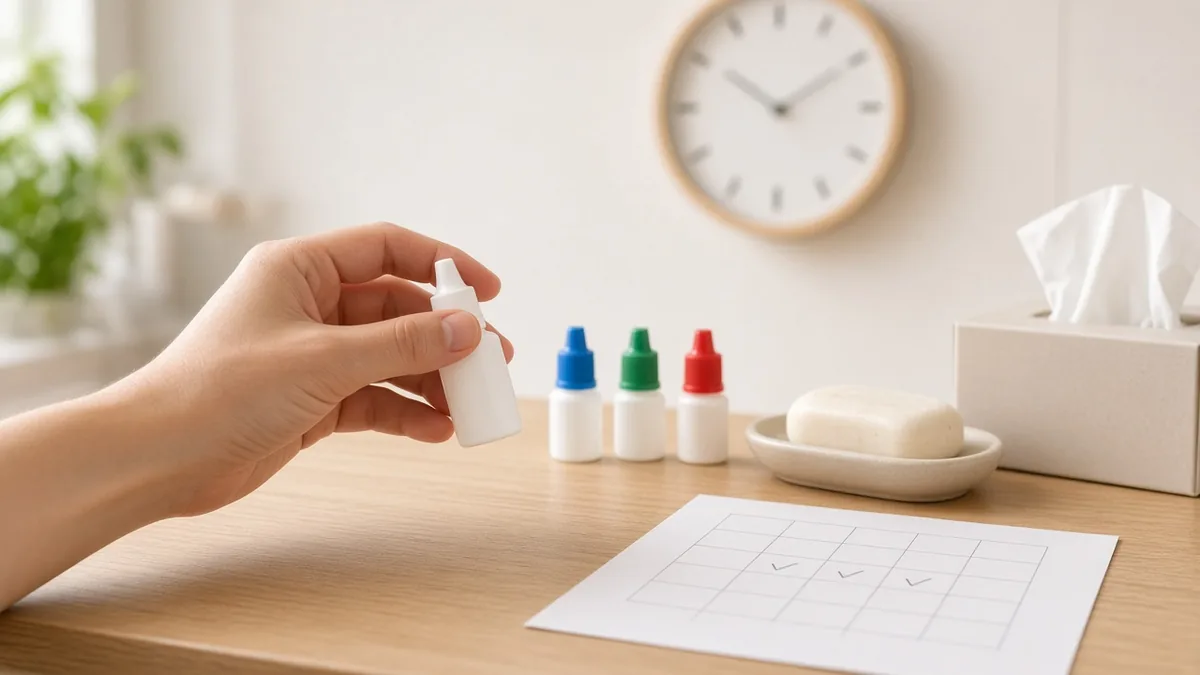

After myopia surgery, you go home with a prescription for eye drops. Putting a drop into a freshly operated eye sounds simple, yet the same question keeps coming up: how should you use your eye drops after LASIK or PRK, and how long should you wait between two drops? Here are the steps recommended by the American Academy of Ophthalmology (AAO) and the U.S. FDA. The products, schedule and duration of treatment remain those set by your eye surgeon on the prescription.
1. What the eye drops are for
According to the FDA, after LASIK your doctor may give you one or more types of eye drops to use at home to help prevent infection and/or inflammation, and may advise artificial tears to lubricate the eye. After PRK, the AAO reminds patients to use eye drop medicine as prescribed by their ophthalmologist and to follow their instructions to help healing.
Treatment is not the same for everyone: it depends on the technique selected by the eye surgeon after the pre-operative assessment and on how healing progresses at each visit. The rule is simple: your prescription is the reference. If you have any doubt about a product, a dose or a stop date, ask your eye surgeon or pharmacist rather than improvising.
2. Getting organised before the day of surgery
In the first days, vision may be blurry and the eye sensitive to light (FDA). It is best to prepare everything in advance:
- reread the prescription and write down the times for each eye drop;
- set up a tracking aid (a tick chart, phone alarms) so you neither forget nor double a dose;
- store the eye drops separately, away from other bottles in the house;
- if needed, ask someone close to you to help with the first drops.
The day itself is described in The day of surgery.
3. Step by step
The AAO describes a simple method:
- wash your hands before handling the bottle or touching your eyes;
- shake the bottle if the leaflet says so, and remove the cap without touching the dropper tip, which could become contaminated;
- tilt your head back slightly and look up;
- gently pull your lower eyelid down to form a small pocket;
- hold the tip above this pocket, without touching the eye, eyelid or lashes, and squeeze gently to release one drop;
- close your eyes and press lightly on the inner corner of the eye, near the nose, for one to two minutes, or as long as your ophthalmologist recommends, so the drop stays in the eye;
- wipe away any excess with a clean tissue on the closed eyelid, then wash your hands again.
After LASIK, these steps are done gently: the FDA stresses not rubbing your eyes, because rubbing can dislodge the corneal flap and require further treatment. Dab, don’t press on the eye.
4. Several eye drops: how long between two drops?
When several eye drops must be used at the same time, the AAO advises waiting 3 to 5 minutes between two different medications.
The order and the number of drops per day are those on your prescription. A simple chart, with one column per eye drop and one box per dose, helps you keep track, especially when the schedule changes from one week to the next.
5. Artificial tears: a few pointers
Artificial tears are often advised to lubricate the eye after surgery (FDA). The AAO explains that preservative-free artificial tears are generally safe to use as often as needed, and that many eye doctors recommend not using drops with preservatives more than four times a day, as preservatives can irritate the eyes.
The product and frequency are specified by your eye surgeon. If your eyes keep feeling dry, more information is available in Dry eye after LASIK.
6. Mistakes to avoid
The AAO points out that bottle mix-ups are common, particularly between eye drops and ear drops, and reports the case of a patient who, after eye surgery, confused his eye drops with a bottle of false-nail glue. Its advice:
- do not store eye drops with other bottles (ear drops, glue, pet medication);
- keep each eye drop in its original box;
- know the name and cap colour of each eye drop, and read the label out loud before each dose;
- throw away leftover bottles once the treatment is over.
Other useful habits: do not share your eye drops, and do not resume wearing a contact lens in the operated eye, even if your vision is still blurry (FDA).
7. When to contact your eye surgeon
The FDA recommends contacting your eye doctor immediately, without waiting for the scheduled visit, if you have severe pain or if your vision or other symptoms get worse instead of better. Redness, burning or swelling that appear after an eye drop also call for advice: the AAO notes that an allergic reaction to eye drops is possible.
To place eye drops among the other instructions, see Life after LASIK, Returning to work after LASIK or PRK and Makeup after myopia surgery. For an overview of myopia correction, see Solutions: glasses, contact lenses, surgery in the Myopia section.
FAQ: eye drops and myopia surgery
How long should I wait between two eye drops?
The AAO advises waiting 3 to 5 minutes between two different eye drops used at the same time. The order and number of drops are those on your prescription.
What if the drop misses my eye?
Wipe your cheek or closed eyelid with a clean tissue, without rubbing the eye, then put in another drop. The technique gets easier with a little practice.
Can I stop the eye drops as soon as I see well?
No. Eye drops are continued for the full duration written on the prescription, even if your vision seems good. Only your eye surgeon can change or stop the treatment.
Can artificial tears be used often?
According to the AAO, preservative-free artificial tears are generally safe to use as often as needed. The product and schedule are specified by your eye surgeon.
Can someone help me put in my eye drops?
Yes. The AAO suggests asking a family member or friend for help if you have difficulty, following the same rules: clean hands and a tip that never touches the eye or lashes.
Going further
- The day of surgery: how it works in practice;
- Life after LASIK: what changes day to day;
- Dry eye after LASIK: duration and solutions;
- Makeup after myopia surgery: when to resume;
- Returning to work after LASIK or PRK: timelines by job;
- Solutions: glasses, contact lenses, surgery: overview;
- LASIK and PRK in detail.
Sources
- American Academy of Ophthalmology. How to Put in Eye Drops. EyeSmart. aao.org
- American Academy of Ophthalmology. Eye Medication Mix-Ups. EyeSmart. aao.org
- American Academy of Ophthalmology. Lubricating Eye Drops for Dry Eyes. EyeSmart. aao.org
- American Academy of Ophthalmology. What Is Photorefractive Keratectomy (PRK)? EyeSmart. aao.org
- U.S. Food and Drug Administration. What should I expect before, during, and after surgery? (LASIK). fda.gov