
Have you heard about "eye surgery" or "laser eye surgery" as a way to rely less on your glasses? The medical term is refractive surgery. But what is refractive surgery, exactly? This article gives its definition, explains its principle, presents the main families of techniques and describes the usual steps, from the pre-operative assessment to follow-up.
Refractive surgery: the definition
Refractive surgery refers to all procedures that correct refractive errors, i.e. the optical errors of the eye: myopia, hyperopia, astigmatism or presbyopia. According to the American Academy of Ophthalmology (AAO), these procedures all share the same goal: focusing light correctly on the retina so that you can see more clearly.
In everyday language, people often talk about laser eye surgery or an eye laser. These expressions usually refer to laser techniques on the cornea, but refractive surgery also includes techniques that use an implant placed inside the eye.
The principle: reshaping the cornea or adding a lens
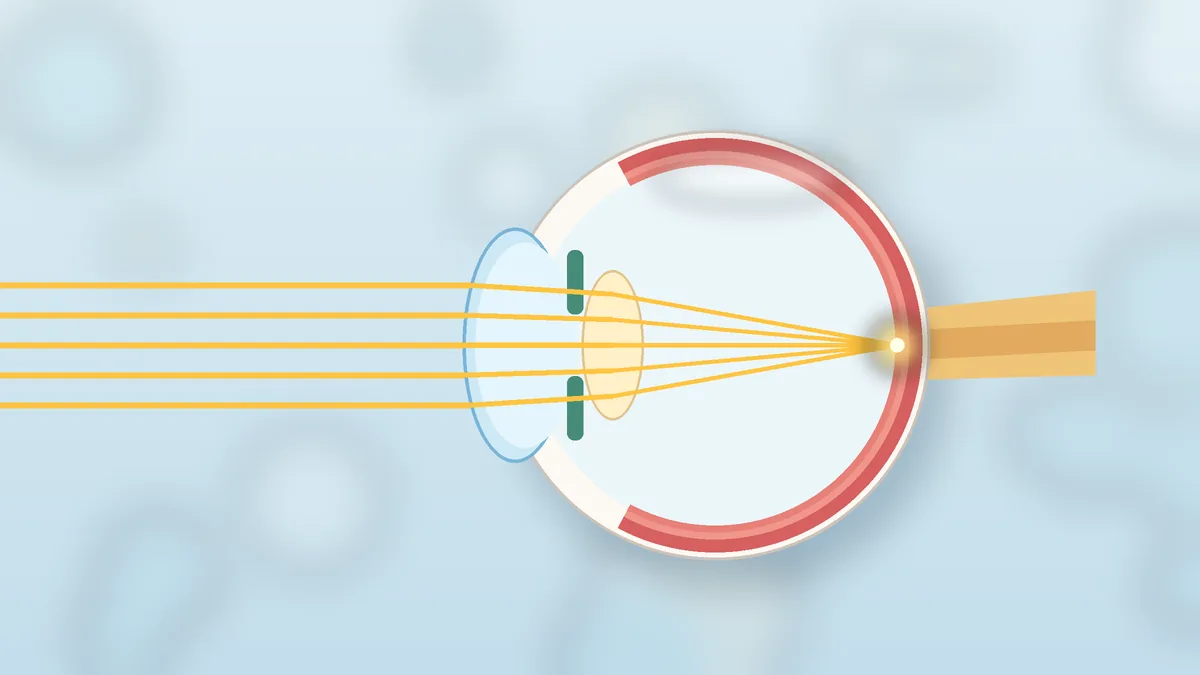
For an image to be sharp, light rays must focus precisely on the retina, at the back of the eye. In a short-sighted eye they focus in front of the retina; in a long-sighted eye, behind it; with astigmatism, the cornea does not bend light in the same way in every direction.
The AAO distinguishes two main approaches:
- reshaping the cornea, the clear lens at the front of the eye, to change its optical power: this is the principle of laser techniques;
- placing a lens inside the eye (implant), which provides the optical correction.
The main families of techniques
According to the AAO, the most common refractive surgery is LASIK; PRK and SMILE are also among the common procedures:
- LASIK: a thin flap is created on the surface of the cornea, the laser reshapes the cornea beneath it, and the flap is then repositioned;
- PRK: the laser works directly on the surface of the cornea, after removal of its thin outer layer (the epithelium), with no flap;
- SMILE: a femtosecond laser creates a thin lenticule within the cornea, which is removed through a small incision;
- implants: a lens placed inside the eye, an approach to discuss in particular for some cases of high myopia or some corneas that are not suited to laser treatment.
These techniques have been compared in Cochrane reviews, for example LASIK and PRK or laser surgery and implants for moderate to high myopia. These reviews describe general differences between techniques, not a rule that applies to every eye. The laser techniques performed by Dr Gozlan are presented on the Techniques page, and their differences in the article LASIK or PRK: what are the differences?
Who decides on the technique?
The technique is not the patient's choice. Dr Gozlan, ophthalmic surgeon, determines it after the pre-operative assessment, based on the examinations: thickness and shape of the cornea, correction needed, age, condition of the eye surface and lifestyle. He explains the technique selected, its expected benefits and its possible risks.
The AAO points out that there is no single best method for everyone and that, sometimes, it is preferable to keep your glasses or contact lenses. If no surgery is suitable for your eyes, the surgeon will tell you.
The steps: from assessment to follow-up
Whatever the technique, the pathway usually has three steps:
- The pre-operative assessment: it checks whether the eyes are suitable for surgery and provides the measurements used to plan the treatment. Contact lens wearers must stop wearing them before this assessment (see when to stop contact lenses);
- The day of surgery: the procedure is carried out according to the technique selected by the surgeon;
- Post-operative follow-up: check-ups are scheduled after the procedure to monitor healing and how vision evolves.
Myopia surgery is considered from the age of 18, with stable myopia. The general criteria are detailed in the article Am I a candidate for myopia surgery? Fees are listed on the Fees page.
What refractive surgery can do, and its limits
The aim of refractive surgery is to reduce dependence on glasses and contact lenses. It is not a guarantee: the AAO stresses that you must accept the risks and possible side effects of surgery, and understand that you may still need glasses or contact lenses to see your best.
The outcome depends on each eye. That is why the ophthalmic surgeon takes the time, during the consultation, to explain what can reasonably be expected in your case.
FAQ: what is refractive surgery?
What is refractive surgery, in one sentence?
It is the set of procedures that correct the optical errors of the eye (myopia, hyperopia, astigmatism, presbyopia), by reshaping the cornea with a laser or by placing a lens inside the eye.
Are "laser eye surgery" and refractive surgery the same thing?
Almost: laser eye surgery, sometimes called "eye laser", is the best-known form of refractive surgery. But refractive surgery also includes implant-based techniques, with no laser on the cornea.
Which vision problems can refractive surgery correct?
According to the AAO, myopia, hyperopia, astigmatism and presbyopia. Whether a correction is possible, and with which technique, depends on the assessment of each eye.
Who decides between LASIK, PRK or an implant?
The ophthalmic surgeon, after the pre-operative assessment and based on the examinations. He explains his reasons, the expected benefits and the possible risks.
Will I still need glasses after refractive surgery?
The aim is to reduce dependence on glasses and contact lenses, with no promise of results. The AAO points out that you may still need glasses or contact lenses to see your best.
Further reading
- Techniques: LASIK, PRK and Presby-LASIK;
- Pre-operative assessment: the examinations performed before surgery;
- Day of surgery: how the procedure takes place;
- Myopia: treatments: glasses, contact lenses and surgery;
- LASIK or PRK: the differences between the two techniques;
- Astigmatism: laser correction at the same time as myopia.
Sources
- American Academy of Ophthalmology. What Is Refractive Surgery? EyeSmart, 2023. aao.org
- Shortt AJ, Allan BD, Evans JR. Laser-assisted in-situ keratomileusis (LASIK) versus photorefractive keratectomy (PRK) for myopia. Cochrane Database Syst Rev. 2013;(1):CD005135. PMID 23440799
- Barsam A, Allan BD. Excimer laser refractive surgery versus phakic intraocular lenses for the correction of moderate to high myopia. Cochrane Database Syst Rev. 2014;(6):CD007679. PMID 24937100